Industry Brief: High Polysilicon Inventories Persist, Overseas Solar-Plus-Storage Bundling Accelerates — EVCity Market Insights

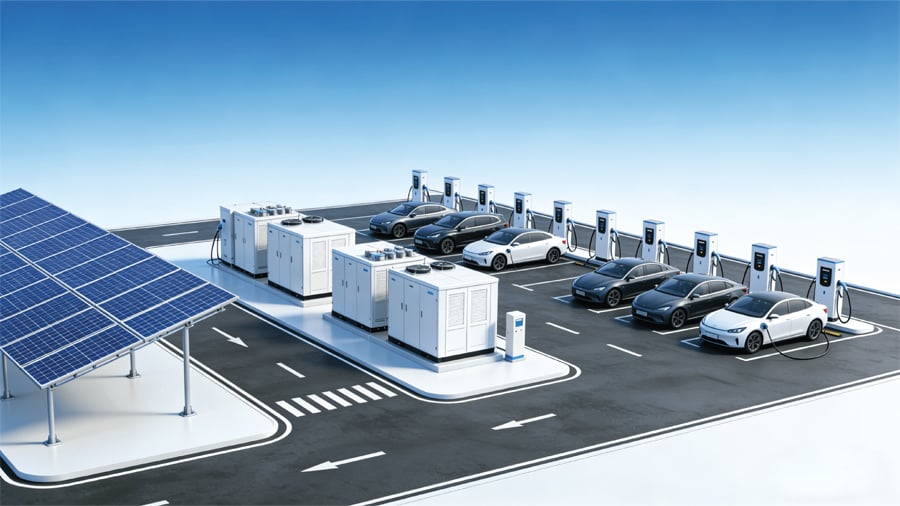
Core View: The upstream PV sector remains in a destocking cycle, with module prices under short-term pressure. Meanwhile, overseas key accounts are accelerating the shift from “buying modules + buying storage” to “buying an integrated solar-plus-storage system.” For brands serving overseas B2B and B2C customers, this creates both a window to optimize system costs and an opportunity for integrated solar-plus-storage-plus-charging brands to establish differentiated positioning.
Upstream: Polysilicon inventories remain elevated; prices unlikely to rebound sharply in the short term
According to EnergyTrend data released on October 22, China’s polysilicon inventories remained above 560,000 metric tons. Domestic output in October was expected to decline by approximately 20,000 metric tons month on month, yet supply still slightly exceeded demand from downstream wafer manufacturers. Although polysilicon producers discussed maintaining selling prices at or above CNY 43/kg, elevated inventories and weak downstream demand continued to cloud the outlook for a sustained price recovery.
Implications for overseas storage brands: Weak module pricing may persist in the near term, helping to lower the overall BOM cost of solar-plus-storage systems. However, amid rising trade barriers, a model that relies solely on low-cost module exports faces growing uncertainty.
Domestic tenders: SOE procurement recovers, but award finalization remains cautious
Data from DataBM showed that between October 3 and October 16, centralized solar module procurement tenders in China totaled approximately 6.6 GW, up sharply from 410 MW in the previous two-week period, largely driven by major procurement programs from state-owned enterprises. During the same period, projects with announced contract awards or shortlisted bidders totaled 2.81 GW, down 35.4% month on month. Tendering activity recovered after the National Day holiday, but the pace of finalizing awards remained relatively moderate.
Policy and trade environment
COP31 trade agenda: On October 21, Li Gao, China’s Vice Minister of Ecology and Environment, stated that China planned to raise concerns about unilateralism and trade protectionism at the COP31 climate summit in November, calling for the free flow of green and low-carbon products and technologies. In recent years, increasing trade restrictions imposed by the United States and Europe on Chinese solar modules and other clean energy products have placed the relationship between climate policy and trade measures in focus ahead of the summit.
Integration of coal-fired power and renewable energy: On October 21, China’s National Energy Administration issued implementation guidelines to promote the integration of coal-fired power generation with renewable energy. The guidelines outline five integration models, encourage flexibility upgrades at coal-fired plants, and support coordinated operation with wind and solar projects. Eligible projects may qualify for financial support under existing government programs.
Overseas signal: LONGi–ENGIE framework agreement confirms the solar-plus-storage bundling trend
On October 19, LONGi signed a global supply framework agreement with French energy group ENGIE, covering 800 MW of back-contact (BC) solar modules and 500 MWh of energy storage products over the next two years for projects in Europe and other international markets. This follows the companies’ cooperation on the 1.5 GW Khazna solar project in the United Arab Emirates, marking an upgrade from single-project cooperation to multi-market, multi-product framework collaboration.
Two points deserve attention:
Solar-plus-storage bundling is becoming a “standard practice” for overseas key accounts. As a leading global energy company, ENGIE’s decision to procure modules and storage products together reflects accelerating acceptance of integrated solutions among European utility customers.
Storage is entering core demand through “native integration.” The 500 MWh of storage included in the agreement leverages LONGi’s LONGi ONE full-stack solar-plus-storage solution, aiming to address system coordination gaps and fragmented responsibility interfaces caused by multi-vendor integration.
EVCity’s differentiated positioning: Amplifying strengths amid the solar-plus-storage trend
The LONGi–ENGIE agreement indicates that overseas key accounts are shifting from fragmented procurement to bundled solar-plus-storage solutions. This presents an opportunity for EVCity: as module manufacturers enter the market through “solar-storage bundling,” independent storage brands must demonstrate their irreplaceability.
EVCity’s three advantages:
Storage-native focus: Energy storage is one of EVCity’s core businesses, with a product portfolio spanning residential storage, C&I storage and EV charging. Unlike module manufacturers that treat storage as a secondary offering, EVCity can go deeper in cell selection, BMS strategy and system safety, better meeting overseas customers’ requirements for lifecycle cost performance.
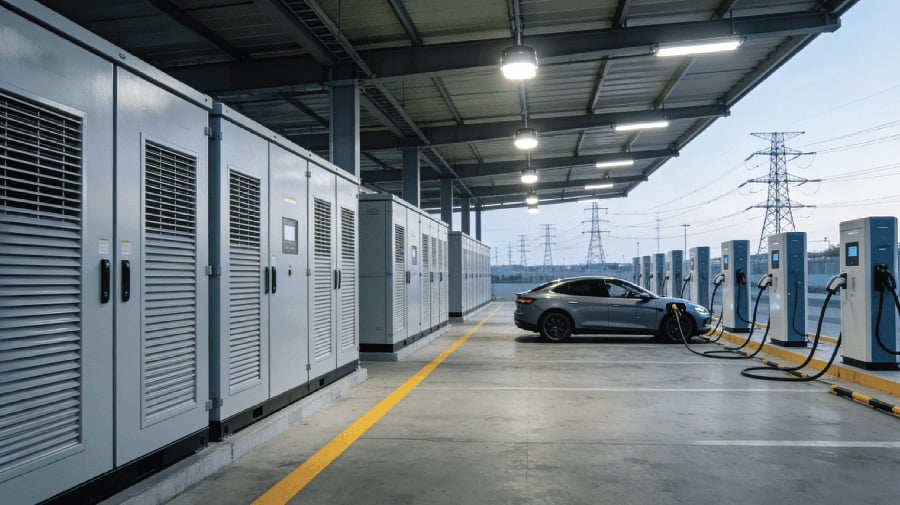
Local market readiness: EVCity is positioned as a brand serving overseas B2B customers, with product certification, compliance adaptation and after-sales support designed around target markets. By contrast, storage products from domestic module manufacturers often prioritize domestic projects, resulting in uneven overseas localization capabilities.
Cross-brand compatibility: Module manufacturers promoting solar-plus-storage bundles naturally tend toward closed combinations of their own modules and storage. However, overseas EPCs and distributors often already have established module suppliers and need storage systems compatible with multiple PV brands. As an independent storage brand, EVCity is not tied to any specific module manufacturer, giving it stronger “plug-and-play” flexibility.
Market outlook
The global energy storage market is projected to reach USD 123.9 billion in 2026, a 15.1% year-on-year increase, while large-scale storage deployments in continental Europe are expected to be roughly three times the 2025 level. With module prices at relatively low levels and overseas demand structurally shifting toward integrated solar-plus-storage solutions, storage brands with flexible product portfolios and strong local service capabilities are well positioned to gain advantage in the next wave of overseas expansion.